
Junk removal
What the JunkRemoval pack adds: load-fraction pricing, cleanouts, disposal lines, and the standing commercial stop.
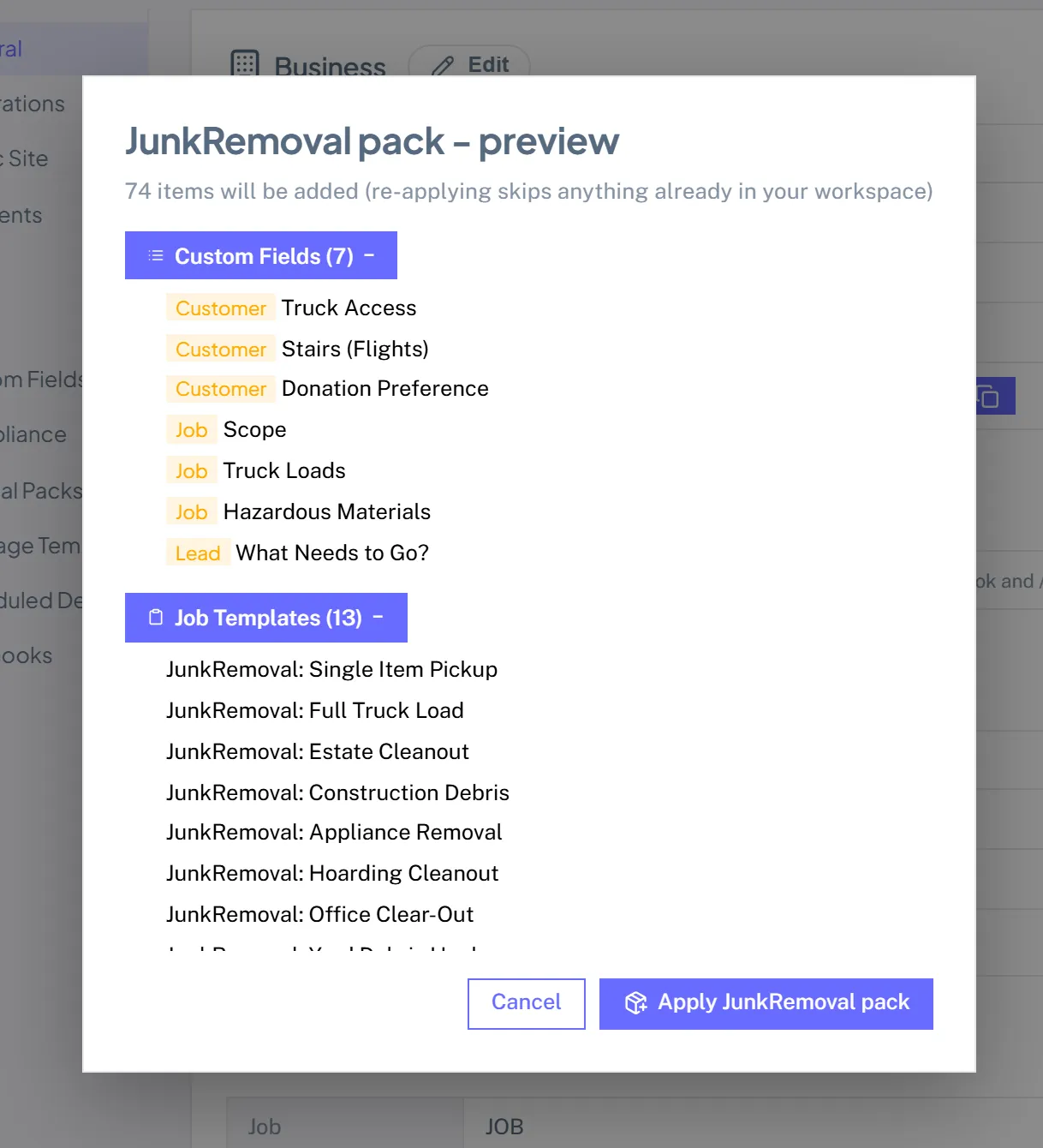
The JunkRemoval pack tunes Manuall for load-priced hauling: single items, truck fractions, estate and hoarding cleanouts, construction debris, yard waste, and the standing monthly stop for a property manager. Apply it at signup from the Trade dropdown, or anytime from Settings -> Vertical Packs.
What the pack adds
Custom fields
- Job (3): Scope (Full Load, Partial Load, Single Item, Cleanout, Demo), Truck Loads, Hazardous Materials.
- Lead (1): What Needs to Go?
Nothing ships on Customer, Equipment or Invoice. Gate codes, dock hours, a property manager's PO number: add those yourself in Custom fields.
Job templates
Thirteen, each with a duration for the slot finder and skills that gate who can be assigned: Single Item Pickup (60 min), Appliance Removal (60), Recurring Commercial Pickup (60), Yard Debris Haul (120), Full Truck Load (180), Garage or Basement Cleanout (180), Hot Tub Removal (180), Construction Debris (240), Shed or Playset Teardown (300), Carpet and Flooring Tear-Out (300), Office Clear-Out (480), Estate Cleanout (1,440), Hoarding Cleanout (2,880).
Only three skills are used: JunkRemoval on all thirteen, Hoarding on the hoarding cleanout, Commercial on the office clear-out and the recurring stop. Tag your crew in Team or every template gates everyone out. The last two durations are calendar span, not crew hours, so trim them or the slot finder blocks days at a time.
Each template also pre-fills billable lines, and that is a starting scope, not a quote: Estate Cleanout drops two crew days, Hoarding Cleanout three, Construction Debris two tons, Garage or Basement Cleanout a half load plus the stairs surcharge, Carpet and Flooring Tear-Out 600 sq ft plus a half load. Office Clear-Out pre-fills one full truck load, which is light for most offices. See Job templates.
Services
Twenty-four price book lines, all badged "Set your price" until you save them.
- Load fractions (4): Single Item or Minimum Load Pickup, Quarter, Half and Full Truck Load Removal.
- Per item (7): Appliance Removal and Haul Away, Mattress and Box Spring Removal, Large Furniture Removal, TV and Electronics Recycling, Piano or Gun Safe Removal, Hot Tub Removal and Disposal, Shed or Playset Teardown and Removal.
- By weight or area (3): Construction and Renovation Debris Removal and Disposal and Landfill Fee, both per ton; Carpet and Padding Tear-Out per sq ft.
- Crew days and recurring (3): Estate Cleanout, Crew Day; Full Property Cleanout, Crew Day; Scheduled Junk Pickup Plan per month.
- Time, trips and adders (7): Hourly Rate, Two-Person Crew; Trip Charge (Junk Removal) at $75 flat, waived when the job goes ahead; Same-Day and After-Hours Premium at $125 on top of the load price; Stairs and Long Carry Surcharge and Yard Waste and Brush Removal, both per load; Donation Center Delivery; Refrigerant Recovery and Disposal Tag.
Prices are a 2025 US national average. Thirteen lines are flagged for public booking and the public site: the four load fractions, the seven per-item lines, yard waste and the monthly plan. Crew days, per-ton lines, the hourly rate and the adders are not, because somebody has to walk those first. The assumption to check is your truck: quarter, half and full only mean something against one bed size, and a 12-yard box truck does not price a load the way a 15-yard dump trailer does. Price book.
Checklists
Three ship, to check against your own crew procedure: Full Truck Checklist (18 items), Cleanout Checklist (14), Pre-Service Safety Check (9). See Checklists. Full Truck attaches to eight templates, Cleanout to Estate and Hoarding, Safety to Single Item Pickup, Appliance Removal and Hot Tub Removal. They are not all checkboxes: Full Truck captures the load fraction billed, cubic yards loaded, scale ticket number, disposal fee and facility at the scale, recycled or donated share, strap count, items refused and why, and photos of the pile, the load and the swept site.
Cleanout captures a Clutter-Hoarding Scale level, valuables and cash found and who took them, medication and sharps, firearms, biohazard, loads hauled, donation receipt number, rooms remaining. Safety captures heaviest single item weight, hazards identified, refrigerant appliance status, respiratory protection, and pre-existing damage photos of walls, floors and doorframes. That last one is the cheapest insurance on the list.
Parts
Twenty-one consumables under a JR- part number prefix, in six groups. Bags and Liners is the biggest at seven: 4 mil and 6 mil contractor bags, woven poly rubble sacks, red biohazard bags, and mattress bags in twin/full, queen and king.
Then Load Securing (stretch wrap, moving blanket, appliance dolly ratchet belt, dump body cargo net), Site Protection (carpet shield film, kraft hardboard runner, foam door jamb protectors), Compliance (sharps container, EPA refrigerant recovery tag), Blades (nail-embedded demo recip blade, carpet hook blade), Containers (e-waste gaylord, donation transfer box).
Cost and price are a national average, on hand is zero, and no reorder point is set, because nothing here knows what is on your truck. Counting it is your first pass in Parts and inventory.
Twenty-two bill-of-materials rows tie those parts to seventeen services, so the tech sees what a job consumes and the office sees what to restock. A full truck load pulls 12 contractor bags. An estate crew day pulls 40, plus half a roll of carpet shield and half a roll of stretch wrap. A full property cleanout day pulls 50 of the 6 mil bags, 25 red bags, two sharps containers and half a roll of hardboard runner. The fractions spread a roll or a box across the jobs that use it up. Book bags and film to overhead instead and you can clear those rows.
Seasonal pricing proposals
Six, all switched off. The engine ignores an inactive rule, so nothing moves until you turn one on in Seasonal pricing.
- Spring Cleaning Surge, March 15 to May 31: Half Truck Load Removal at 1.15. Every garage and attic lands in the same eight weeks.
- Moving Season, June 1 to August 31: Full Property Cleanout, Crew Day at 1.15, against a hard closing date.
- Fall Cleanup, October 1 to November 30: Yard Waste and Brush Removal at 1.15.
- Winter Slow Season, January 2 to February 28: Quarter Truck Load Removal at 0.88, because a moving truck beats a parked one.
Typical workflow
- A call or a form lands as a lead with What Needs to Go? captured. Thirteen services are booking-flagged, so a mattress, a fridge or a half load books itself off the site without a phone call.
- Same day is the sale. Assign off the dispatch board, sequence stops in Map and routes, and put Same-Day and After-Hours Premium on as its own line so the surcharge shows on the invoice instead of hiding inside a bigger load price.
- Estate and hoarding work is a multi-day crew commitment. Quote it as an estimate with a deposit; the deposit holds the crew and the truck against a date you cannot resell. The photos go back through the customer portal to an executor or manager who was never on site.
- The Scheduled Junk Pickup Plan is the repeat revenue. Wrap it in a service agreement, put the Recurring Commercial Pickup template on a recurring job, and bill it with a recurring invoice so nobody re-keys the same monthly figure.
- Flag Hazardous Materials on the job and the crew stops rather than guesses. Paint, solvents, propane, fuel and suspected asbestos do not go in the truck, and a biohazard answer of stop-work means a specialty contractor, logged in Subcontractors.
Selling by the load while the scale bills by the ton
The trade prices volume and pays weight. You quote a half load, the transfer station weighs the truck, and the loads that hurt are the heavy ones that look small: tile, plaster, wet carpet, a shed full of soaked lumber. The Full Truck Checklist exists for that gap. Cubic yards loaded, scale ticket number, disposal fee paid at the scale and facility used give you a real cost per load, and after a month of tickets you can say which fraction is underpriced instead of guessing.
Disposal and Landfill Fee ships at $95 against a cost of $85 per ton, a pass-through with a thin rider on it. Tip fees swing hard by metro, and mattresses, tires, appliances and construction loads usually carry their own surcharge at the gate that this one line does not model. Decide too whether disposal shows as its own line or is baked into the load price, because doing both bills it twice and the customer who spots it says so in the review.
Refrigerant is the other one to get right. A fridge, freezer, window AC or dehumidifier needs certified recovery and the tag before most facilities will take it. That is why the safety check asks whether a refrigerant appliance is present and whether recovery is arranged, with a do-not-haul answer in the list, and why Refrigerant Recovery and Disposal Tag is a billable line instead of something absorbed on the truck.
Re-applying and mixing packs
Apply a pack twice and it only adds what is missing, so your prices and your rewritten checklist items survive. Junk shops commonly run a second pack: Cleaning for the move-out clean behind the cleanout, Handyman for the small repairs a turnover needs, Flooring if the carpet tear-out already has you on the subfloor, and Tree Service if the brush side of the truck pays. Apply as many as fit from Vertical Packs.