
Pest Control
What the Pest Control pack adds: quarterly programs, termite work, one-time treatments.
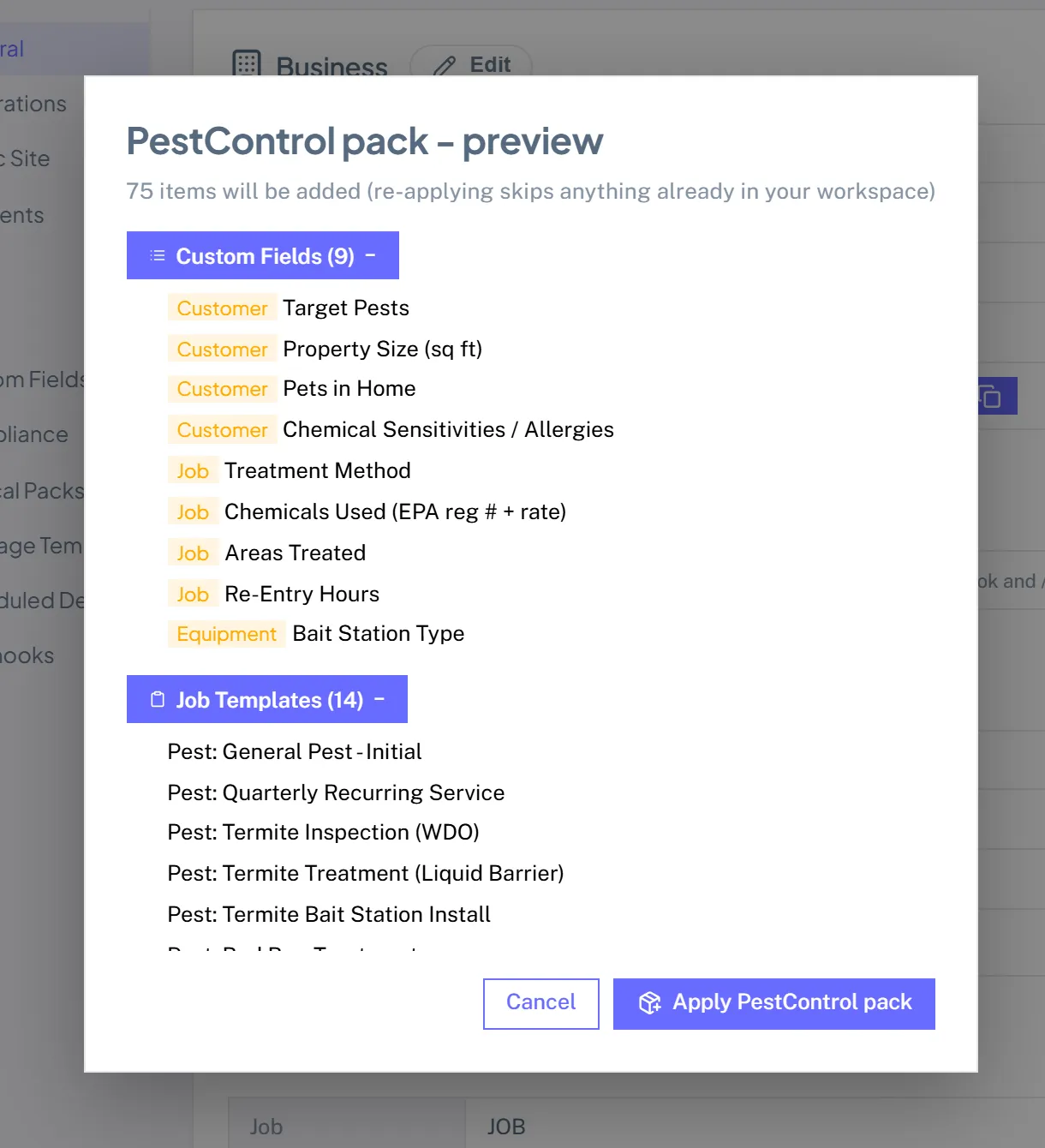
The Pest Control pack tunes Manuall for quarterly programs, termite work, one-time treatments, commercial station routes, and rodent remediation. Apply it at signup or from Settings -> Vertical Packs.
What the pack adds
Custom fields
Nine, none of them required.
- Customer (4): Target Pests, Property Size (sq ft), Pets in Home, Chemical Sensitivities / Allergies.
- Job (4): Treatment Method, Chemicals Used (EPA reg # + rate), Areas Treated, Re-Entry Hours.
- Equipment (1): Bait Station Type, so a station route reads off the equipment record.
No applicator license field ships. The license number is a checklist item on the pesticide documentation list instead, which lands it per application rather than per customer. Nothing tracks a warranty term either; hold a termite warranty on a service contract. Add or drop fields at Custom Fields.
Job templates
Fourteen, each with a duration for the slot finder. General Pest - Initial 75 min, Quarterly Recurring Service 30, Termite Inspection (WDO) 60, Termite Treatment (Liquid Barrier) 240, Termite Bait Station Install 120, Bed Bug Treatment 360, Rodent Exclusion + Trapping 180, Rodent Follow-Up Trap Check 45, Mosquito / Flea / Tick Yard Treatment 60, Wildlife Removal 90, Attic Cleanout and Insulation Removal 300, German Roach Cleanout 90, Commercial Monthly Service 60, Emergency After-Hours Callout 75.
Required skills are pre-filled: PestControl on all fourteen, plus Applicator on the seven that apply product, Termite on the three termite jobs, Rodent on three, and BedBug and Wildlife on one each. If nobody carries those tags at Team and Availability, the slot finder gates every tech off those jobs.
All fourteen pre-fill billable lines, and two guess at a quantity. Attic Cleanout pre-fills 600 sq ft of droppings cleanup plus 600 sq ft of insulation haul-away, and Commercial Monthly pre-fills eight bait stations. Measure the attic and count the stations on the account before the invoice goes out. Twelve of the fourteen carry a linked checklist; Rodent Exclusion + Trapping and Wildlife Removal do not, so link one at Job Templates if you want paperwork on those.
Services
Twenty-five price book lines, each with all three tiers (Default, Member, Commercial) and a cost, all badged "Set your price" until you save them.
- General pest and spot work: Initial Pest Treatment, Quarterly Pest Service Visit, Monthly Pest Service Visit, One-Time Pest Treatment, German Roach Cleanout Treatment, Interior Flea Treatment, Wasp and Hornet Nest Removal.
- Termite: Termite Inspection and Report, Termite Treatment Liquid Soil Barrier, Termite Bait System Installation First Year Monitoring Included, Annual Termite Warranty Renewal.
- Bed bug: Bed Bug Heat Treatment, Bed Bug Treatment Per Room.
- Rodent and wildlife: Rodent Exclusion and Trapping, Rodent Follow-Up Trap Check Visit, Exterior Rodent Bait Station Service Per Station, Rodent Droppings Cleanup and Sanitizing, Contaminated Attic Insulation Removal and Haul-Away, Wildlife Trapping and Removal, Dead Animal Removal and Deodorizing.
- Mosquito: Mosquito Yard Treatment, Mosquito Season Program.
- Labor and fees: Service Call and Inspection Fee, Hourly Rate (Pest Control), After-Hours and Emergency Response (Pest Control).
Nine are flagged for public booking and the public site: the initial and one-time treatments, the termite inspection, mosquito yard, wasp and hornet, the service call fee, the roach cleanout, interior flea, and dead animal removal. Recurring visits, termite treatments and bed bug work stay off, which is right. Those get quoted, not picked off a dropdown.
Two things to settle before you quote off any of it. The two attic lines bill per sq ft, so the number you set is a rate and not a job. And termite and bed bug carry the widest spread in the pack: crawlspace versus slab, linear feet and a Formosan market move liquid barrier a long way from the baseline, and bed bug pricing swings on property size more than on protocol.
Checklists
Three, fifty items between them, shipped for you to check against your own procedure at Checklists. Most capture a reading or a choice rather than a tick.
- Pesticide Application Documentation, 19 items, linked to eight templates. Product and EPA reg number, rate and total volume, dilution, finished gallons, area treated, application method, formulation, wind and temperature, rain forecast, sensitive site, pollinator timing, re-entry, and a photo of the product label. Two required: the product and EPA reg number, and that label photo.
- Termite Inspection Report Items, 18 items, linked to the WDO inspection. Inspection type including Real Estate NPMA-33, linear feet, obstructed areas, subfloor moisture, crawlspace soil, wood-to-soil contact count, grade to siding clearance, live activity by species, and three photos. Two required: foundation perimeter inspected, and report delivered to the customer or agent.
- Pre-Service Safety Check, 13 items, linked to Bed Bug Treatment, Rodent Follow-Up Trap Check and Attic Cleanout. PPE, label and SDS, respirator cartridge date, tank pressure and output, aquarium and food covered. Three required: PPE per label, applicator certification current for the category treated, and the area cleared of pets, children and people.
Parts
Twenty truck items across eleven categories: Rodent Control carries four, Liquid Concentrates, Baits, Dusts, Exclusion, Bed Bug and Termite two each, and Aerosols, Monitoring, Sanitation and Wildlife one each. Cost and price are a national average, stock starts at zero and no reorder point is set, because nothing here knows what is on your truck. Count it once and set your own numbers at Parts and Inventory.
The actives are named, not generic: bifenthrin perimeter concentrate, fipronil termiticide, indoxacarb roach gel, thiamethoxam ant gel, chlorfenapyr bed bug residual, pyriproxyfen IGR, bromadiolone bait block, deltamethrin dust and silica aerogel. If your shop runs a different chemical line, rename the part rather than adding a second one, or your usage history splits across two rows.
The bill of materials wires 40 rows to 20 services, so a tech opening a service sees what the job consumes and the office sees what to keep stocked. Rodent Exclusion and Trapping carries the most at five (copper mesh, pest-block foam, rat and mouse snap traps, exterior bait station); German Roach Cleanout Treatment carries four. Every part is wired to at least one service. The quantity on each row is a per-job average, so check it against a real ticket before you cost off it.
Seasonal pricing proposals
Four rules, all shipped switched off. The engine ignores an inactive rule, so nothing moves until you open one and turn it on at Seasonal Pricing.
- Peak Mosquito Season, May 15 to Sep 15, 1.15x on Mosquito Yard Treatment.
- Late Summer Nest Peak, Jul 15 to Sep 30, 1.20x on Wasp and Hornet Nest Removal.
- Fall Rodent Push, Oct 1 to Dec 31, 1.15x on Rodent Exclusion and Trapping.
- Winter Slow Season, Jan 1 to Feb 28, 0.90x on Initial Pest Treatment. A discount, to buy the quarterly account in the month nobody sees a bug.
Each rule touches one service. The mosquito rule does not reach Mosquito Season Program, so a prepaid bundle sold in July stays at the price you set. Winter Slow Season ends Feb 28, so a leap-year Feb 29 falls outside it. Sun Belt and termite-belt shops should look hard at the fall rodent push and the winter discount, because neither seasonal shape matches a market where the phone rings all twelve months.
Typical workflow
- Quarterly customers run on a recurring job every 90 days plus a recurring invoice on whatever cycle you sold.
- Initial treatments are a separate one-time job, often discounted to lock in the contract.
- Real-estate termite letters are quick, high-value jobs on a closing deadline. Book them at the front of the day and get the report out the same afternoon.
- Rodent work is a two-visit minimum. Open with Rodent Exclusion + Trapping, run Rodent Follow-Up Trap Check on the returns, and quote the attic cleanout off what you find once the exclusion is verified sealed.
- Commercial accounts run monthly on a station route. The service log stays on site for the health inspector, and the eight-station default is a small restaurant, not a warehouse.
Compliance to watch
- Your state structural pest control license. The applicator license number is captured per application on the pesticide documentation checklist.
- EPA product-registration records, tracked per job in the Chemicals Used field and again on the checklist with rate, method and finished volume.
- Termite and WDO reporting for real-estate transactions. The inspection checklist carries the NPMA-33 inspection type and a report-delivered item.
- Re-entry intervals. There is a Re-Entry Hours field on the job and a communicated item on both the documentation and the safety checklist.
Re-applying and mixing packs
Applying a pack twice adds only what is missing, so re-apply after an update without losing an edit. Lawn Care is the common second pack, since the mosquito and tick work is already on the same yard route. Mold Remediation suits shops that take the attic and crawlspace cleanup a rodent job opens up. Apply either from Settings -> Vertical Packs.