
Water restoration
What the WaterRestoration pack adds: emergency extraction, structural drying with logged readings, sewage, contents, and the claim package.
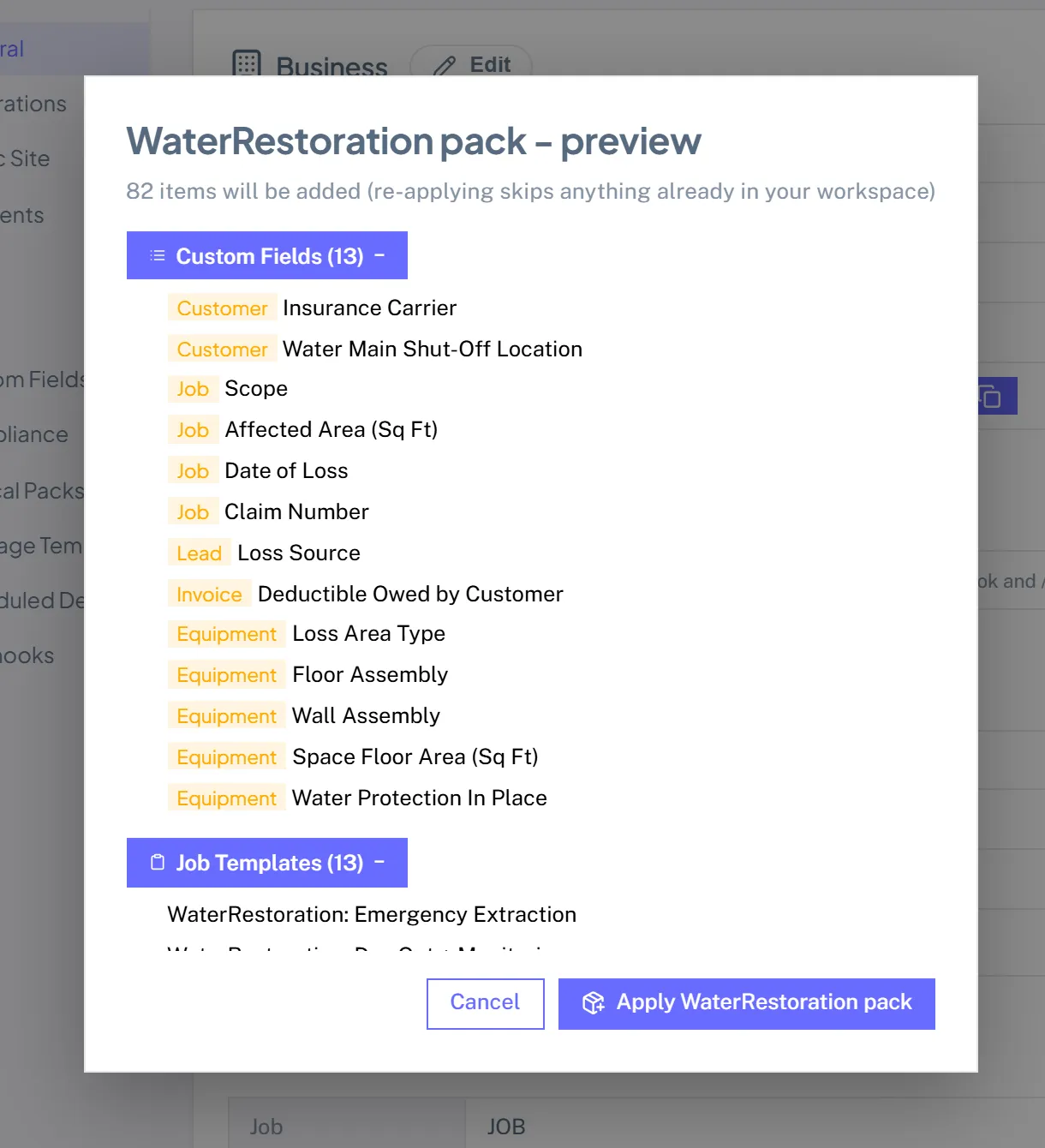
The WaterRestoration pack tunes Manuall for the call at 2am, the four days of drying that follow, and the documentation that gets the invoice paid. Extraction, structural drying and monitoring, hardwood mat drying, sewage, demo and rebuild, contents pack-out, and the equipment pull. Apply it at signup from the Trade dropdown, or anytime from Settings -> Vertical Packs. It ships 7 custom fields, 13 job templates, 24 services, 3 checklists with 44 items, 20 parts wired to those services by 20 bill-of-materials rows, and 4 seasonal pricing proposals.
What the pack adds
Custom fields
- Job: Scope (Extract, Dry-Out, Demo, Mold Prevention, Rebuild), Affected Area (Sq Ft).
- Equipment: Loss Area Type (Basement, Crawl Space, Slab-on-Grade, Main Floor, Upper Floor, Attic, Commercial Unit), Floor Assembly, Wall Assembly, Space Floor Area (Sq Ft), Water Protection In Place (None through Interior Drain and Sump).
The Equipment fields describe a space, not a machine: the pack assumes you make an Equipment record for the basement or crawl you dried, so the next loss at that address opens with the assembly known. To carry it per visit instead, add the same fields on Job and switch the Equipment ones off in Custom Fields. Nothing ships on Customer, Lead or Invoice. Carrier, claim number and adjuster contact are a checklist item, so add a Job field if you need to search by claim number.
Job templates
Thirteen, each with a duration, required skills, and a checklist attached, so applying one sizes the slot and gates who can take it.
- Emergency: Emergency Extraction (120 min), After-Hours Emergency Call-Out (180), Sump Pump Failure Response (300, Repair).
- Drying: Dry-Out + Monitoring (480), Hardwood Floor Drying (300), Equipment Pull + Final Documentation (90).
- Category 3 and structure: Sewage Cleanup (960), Demo + Rebuild (1440, Installation), Mold Prevention Treatment (240), Leak Source Repair (240, Repair).
- Documentation and recurring: Inspection + Moisture Map (120, Inspection), Contents Pack-Out (960), Annual Water Protection Plan Visit (90, Recurring).
Every template carries DefaultServices, so the billable lines land with the template. Emergency Extraction pre-fills Water Extraction at 400 sq ft and After-Hours at 350, so if your average loss is a kitchen and not a finished basement, fix the qty or every emergency bills high. The rental lines are machine-days, not machines: After-Hours pre-fills 12 air mover days and 4 dehumidifier days, which is four movers for three days.
Sump Pump Failure Response pre-fills a whole pump replacement, so when the fault turns out to be a stuck float, delete the line before you invoice. It also wants WaterRestoration, Extraction and Plumbing on the same tech; Demo + Rebuild wants Construction, Equipment Pull wants Documentation. Set skills in Team and availability or the slot finder returns nobody.
Services
Twenty-four lines. Response and labor: Emergency Response Call-Out, After-Hours Emergency Response Premium (flat rate), Restoration Labor (per hour). By the square foot: Water Extraction, Sewage Cleanup and Disinfection, Antimicrobial Treatment (Water Restoration), Odor Treatment and Deodorization, Hardwood Floor Drying System, Removal and Disposal of Water-Damaged Materials, Reconstruction and Finish. By the linear foot: Wall Cavity Drying, Containment Barrier. By the day: Daily Drying Monitoring Visit, Air Mover Rental, Dehumidifier Rental, Air Scrubber Rental.
Then Moisture Inspection and Written Report, Insurance Claim Documentation Package, Contents Pack-Out and Inventory (per room), Contents Cleaning and Drying (per item), Debris Disposal Container (per load), Drying Equipment Pickup, Sump Pump Replacement (Water Restoration), and the Annual Water Protection Plan. Prices are 2025 US national averages, each badged "Set your price" until you save it. Debris Disposal ships at 595 against a 385 cost, a pass-through worth repricing to your local haul rate.
Four are visible on Public Booking and the public site: the call-out, the moisture inspection, the sump pump replacement, the protection plan. The rest are hidden, because nobody books a sewage job off a dropdown. Flip either flag per service in the Price Book.
Checklists
Three, shipped for you to check against your own procedure. The number and select fields are the point: they turn a visit into a record.
- Emergency Response Checklist (17 items): source stopped, power killed, water extracted, category and class per S500 as selects, time of loss onset, affected area measured, unaffected control moisture, ambient temperature and RH, extraction volume, a photo of the source before repair, a wide shot of each room before work, work authorization and direction to pay signed, and carrier, claim number and adjuster contact.
- Dry-Out Checklist (18 items): air mover, dehumidifier and scrubber counts placed, chamber temperature and RH, dehumidifier intake and exhaust GPP, today's wall reading, today's subfloor or structural reading, today's unaffected control reading, drying goal met on consecutive readings as a select, a photo of the meter with the reading visible, and the customer signature on today's log.
- Pre-Service Safety Check (9 items): electrical and water hazard, GFCI on all cords, circuit amp draw with equipment running, PPE level for the water category, respirator type and cartridge, overhead water load and ceiling condition, and pre-1980 asbestos or lead status.
Parts
Twenty-three truck-stock items on a WR- prefix: botanical antimicrobial, sporicidal disinfectant and fogging deodorizer; containment poly, zipper doors and seam tape; air scrubber HEPA and carbon pre-filters; lay-flat duct and LGR intake filters; Cat 3 waste bags; mold-resistant drywall and primed base; a cast iron sump pump and check valve; dish packs, packing paper and numbered inventory labels; a battery leak alarm and a Wi-Fi automatic shut-off valve.
They arrive at a national-average cost and price with zero on hand and no reorder point, because nothing can know what is on your truck. Count what you carry, then set reorder points on what stops a job: sporicide, Cat 3 bags, poly, zipper doors. See Parts and inventory.
Twenty bill-of-materials rows tie parts to the services that consume them, at per-unit rates: antimicrobial draws a gallon per 400 sq ft, sewage draws a Cat 3 bag per 28 sq ft, and the rental lines draw filters per machine-day, so a two-week dry-out debits filters at the rate you burn them. One row to look at: the Annual Water Protection Plan lists two leak alarms and one shut-off valve, both optional. If you do not hand out the valve with every plan, drop that row or the plan reads like it costs you 425 dollars a year.
Seasonal pricing proposals
Six rules, all shipped switched off. The pricing engine ignores an inactive rule, so nothing moves until you turn one on in Seasonal pricing. They assume a freeze market and a hurricane coast; most shops are one or the other and plenty are neither, so leave the ones that do not describe your weather off.
- Freeze and Burst Pipe Season: +25% on the Emergency Response Call-Out, Dec 1 to Feb 28.
- Freeze Season Equipment Squeeze: +20% on Air Mover Rental, Dec 1 to Feb 28.
- Spring Melt and Storm Season: +12% on Water Extraction, Mar 1 to May 31.
- Peak Hurricane Season: +15% on Dehumidifier Rental, Aug 1 to Oct 31.
Typical workflow
- The call comes in and the job is created from an emergency template. Confirm the after-hours premium on the phone before the truck rolls, because it is the line customers argue about later.
- On site, the Emergency Response Checklist runs the first hour: source, power, category, class, control reading, photos of every affected room before anything moves. Get the work authorization and direction to pay signed on the phone while you are standing there.
- Drying is daily work, not a status. Dry-Out + Monitoring pre-fills three monitoring visits; put each on the calendar and send it out from the Dispatch board like any other job.
- Equipment Pull + Final Documentation closes it: final readings on consecutive days, meter photos, every machine counted off the job, then the claim package and the invoice off the lines the templates dropped.
- Rebuild is its own conversation. Quote it as an estimate with a deposit, and if you sub the finish carpentry or flooring, track that spend on Subcontractors so it lands against the job margin.
- Sell the Annual Water Protection Plan at the end of a loss, when the customer never wants this again. It runs as a recurring job under a service agreement.
Drying logs, daily readings, and the carrier
The control reading is the log. An affected reading on its own proves nothing; what an adjuster compares is affected material against unaffected material of the same type in the same building. The Dry-Out Checklist asks for the control every day for that reason. Take it before you set a single air mover, on the same species and assembly you are drying.
Log every day you have equipment on the floor. Chamber temperature and RH, intake and exhaust GPP, the counts of what is running, today's readings. A carrier reviewing four monitoring visits wants four days of numbers, and the difference between drying and stalling shows in the GPP spread long before the material reading moves. Pull on the standard, not the schedule: the goal has to hold across consecutive daily checks and match the control, which is what the last Dry-Out select asks.
Billing an insurer. Manuall bills your customer of record, the homeowner, and the carrier pays behind them. That works for the deductible, for self-pay, and for time-and-materials mitigation. It is not a carrier estimating platform: there is no Xactimate integration, so on a program the scope and line items come from their estimate and you will re-key. Use this price book for self-pay and T&M, attach the photos and the moisture log to the job, and let the Insurance Claim Documentation Package line cover the hour it takes to assemble the file.
Re-applying and mixing packs
Applying the pack twice adds only what is missing; it never overwrites a price you set or a checklist you edited. A mold pack has not shipped, so Mold Prevention Treatment covers that near end for now. Plumbing is the usual second pack, since half your losses start at a supply line and Leak Source Repair gates on a Plumbing skill. Carpet Cleaning and Flooring suit shops that finish what they tear out, and Septic pairs with Cat 3 work.