
Water treatment
What the WaterTreatment pack adds: softeners, filtration, RO, UV, water testing, and the salt route.
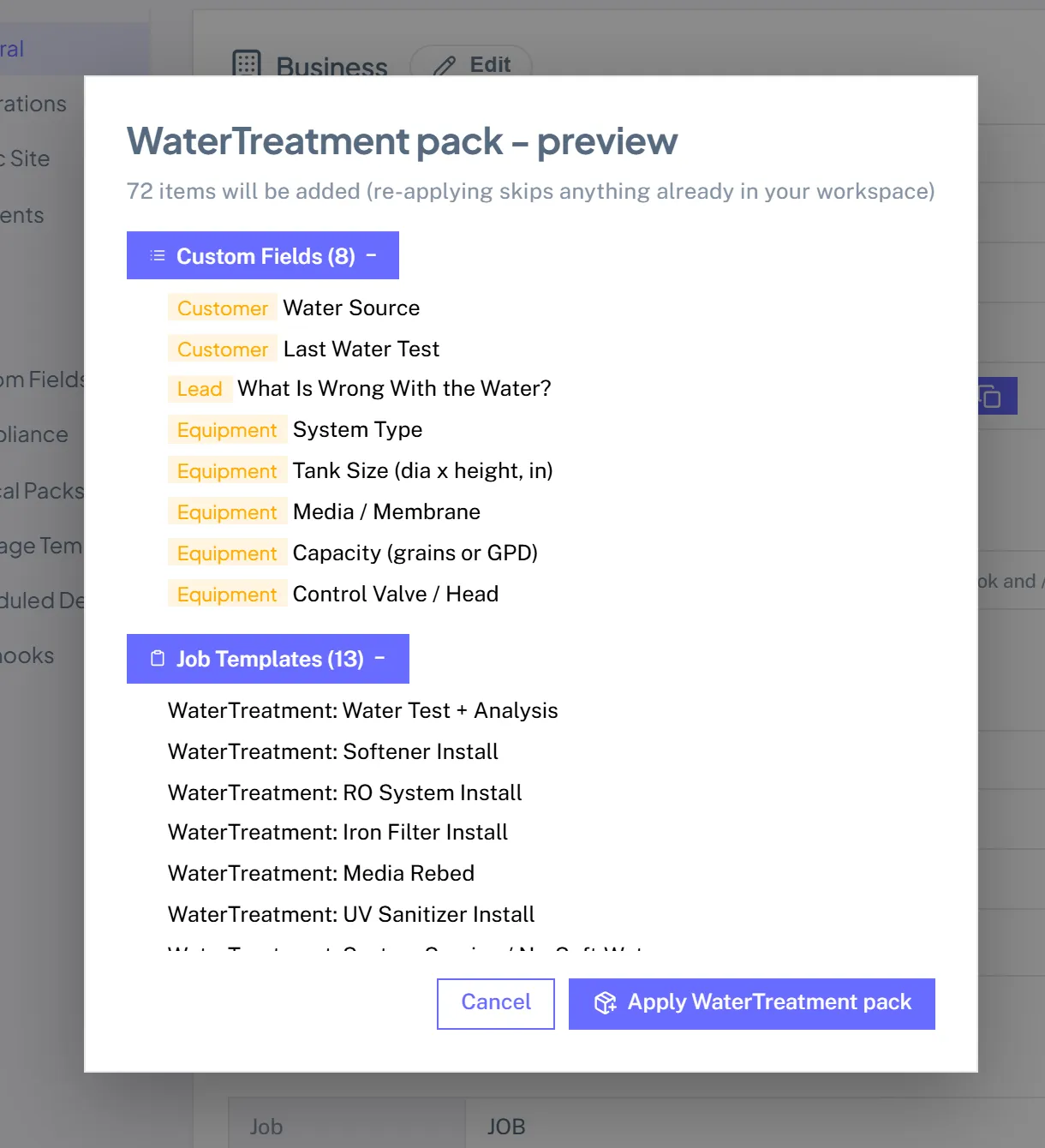
The WaterTreatment pack tunes Manuall for softeners, iron and sulfur filters, acid neutralizers, whole-house carbon, under-sink RO, UV disinfection, and the testing and salt work that keeps them running. Apply it at signup (the Trade dropdown) or anytime from Settings -> Vertical Packs.
What the pack adds
Custom fields
- Customer: Water Source (City / Municipal, Well, Spring), Last Water Test.
- Equipment: System Type (Softener, Reverse Osmosis, Iron Filter, Neutralizer, UV Sanitizer, Sediment Filter, Whole-House Carbon, Chemical Feed), Tank Size (dia x height, in), Media / Membrane, Capacity (grains or GPD), Control Valve / Head.
- Lead: What Is Wrong With the Water?
- Job: Hardness at Test (gpg), Salt Added (Bags). The two numbers a visit exists to produce, so they sort and total instead of sitting in a note.
Well depth and anything else you log per visit are yours to add in Custom Fields. The Equipment fields are the ones that pay you back: log tank size, media and valve model at install, and the tech on next year's rebed knows what to load without a phone call. If you serve cistern or hauled water, add that option to Water Source.
Job templates
Thirteen, each with a duration and required skills pre-filled so the slot finder sizes the visit and gates who can take it.
- Installs (240 to 300 min, skills WaterTreatment + Plumbing): Softener Install, Softener Replacement, Iron Filter Install, RO System Install, UV Sanitizer Install.
- Service and repair (WaterTreatment): Water Test + Analysis (90), System Service / No-Soft-Water (120), Media Rebed (240), Sanitize + Shock (120).
- Recurring and maintenance: Annual Water Care Visit (90), RO Filter Change (45), UV Lamp and Sleeve Replacement (60), Salt Delivery (30).
Each carries DefaultServices, so applying a template drops the billable line on the job already: Softener Replacement pre-fills the install, the haul-away and the sanitize. Two assumptions to check. The installs gate on a Plumbing skill, so a tech not tagged with both never shows as a candidate; set skills first in Team and availability. And Media Rebed pre-fills Filter Media Replacement at qty 1.5, a 10x54 softener. If you mostly rebed 1 or 2 cubic foot tanks, fix the qty or every rebed bills wrong.
Services
Twenty-four lines. Seven installs (standard and twin-tank softener, RO, iron and sulfur, acid neutralizer, UV, whole-house carbon); repair work (service call and diagnosis, control valve rebuild, resin replacement, filter media per cubic foot, RO membrane); maintenance (annual service and water test, RO filter change, UV lamp and quartz sleeve, whole-house cartridge, brine tank cleaning, sanitizing). Then Water Test and Treatment Recommendation, Salt Delivery and Brine Tank Fill (Up to 6 Bags), Water Care Plan Membership, Old Equipment Removal, Hourly Rate, and an After-Hours Premium.
Prices are 2025 US national averages and every line arrives badged "Set your price"; saving the service clears the badge. Margins here swing hard on what you pay for a valve and a cubic foot of resin, so walk the list before quoting.
Ten of them ship visible on Public Booking and the public site: water test, service call, sanitize, brine tank cleaning, annual service, salt delivery, RO filter change, UV lamp, cartridge change, care plan. Installs are hidden, because a softener install is a quote, not a checkbox. Flip either flag per service in the Price Book.
Checklists
Three, shipped for you to check against your own procedure. The number fields are the point: raw and treated hardness written down at every visit is what closes the next system, and the proof when a customer says it never worked.
- Install Checklist (20 items): bypass and shut-offs, drain and brine line, air gap per code, raw and treated hardness, pH, iron and TDS as numbers, salt dose set, regeneration setting, a manual regen through backwash / brine draw / rinse, plus nameplate and finished-install photos.
- Service Call Checklist (18 items): raw and treated readings, valve position on arrival, error code on the head, salt level, drain flow during backwash, injector and brine valve cleaned, resin condition, and a photo of any leak or corrosion found.
- Pre-Service Safety Check (8 items): main shut-off located, PPE, cross-contamination risk, known or suspected bacteria in the supply, SDS on the truck, GFCI on the valve outlet.
Parts
Twenty truck-stock items on a WT- prefix: salt pellets, resin, calcite, sediment and carbon block cartridges, RO pre and post filter set, RO membrane, housing O-rings, UV lamp and quartz sleeve, valve seal kit, piston, transformer, safety brine valve and float, brine injector and screen, bypass valve, drain and brine tubing, a test reagent kit, shock sanitizer pellets.
They arrive at a national-average cost and price with zero on hand and no reorder point, because nothing can know what is on your truck. Count what you carry, then set reorder points on what you never want to be short of: seal kit, injector, UV lamp. See Parts and inventory. Twenty-nine bill-of-materials rows tie parts to the services that use them, so a softener install pulls bypass, drain line, brine line and safety valve off stock. Salt Delivery pulls six bags; if your drop is a different count, edit the service and its BOM row together.
Seasonal pricing proposals
Four rules, all shipped switched off. The pricing engine ignores an inactive rule, so nothing moves until you turn one on in Seasonal pricing. In a market with no real winter or no wells, most of these are wrong for you; leave them off.
- Winter Salt Season: +15% on Salt Delivery, Dec 1 to Feb 28.
- Well and Home Sale Season: +12% on the water test, Apr 1 to Aug 31.
- Spring Flood Season: +15% on System Sanitizing, Mar 15 to May 31.
- Winter Slow Season: -10% on Softener Installation, Jan 5 to Feb 28.
Typical workflow
- A complaint arrives as a lead: water smells like eggs, spots on the glasses, blue-green staining. The Lead field keeps it in the customer's words, which is what you test against.
- The water test is the sales call. Test on site, write the recommendation, send the system as an estimate with a deposit. A four-figure softener or twin-tank is deposit work.
- Install day runs off the Install Checklist. Log tank, media, capacity and valve on the Equipment record so the next visit starts from what this one learned.
- Filter changes, lamp swaps and annual visits are recurring jobs under a service agreement. The care plan drives the Member tier in the price book.
- Salt runs are their own 30-minute template. Batch them by area on Map and routes instead of dispatching them one at a time.
- No-soft-water calls are same-day. Diagnose, then choose: valve rebuild, rebed, or replace. All three are already priced.
Tests, salt, and the filter-change agreement
The test. Last Water Test on the customer record tells you who is due for a retest, and a retest is how a fifteen-year-old softener becomes a new one. Test raw and treated on every service call, not just the sale, and record both numbers.
Salt. Low ticket, high frequency, and the reason you are in that basement twice a year. Run it as a route. It also puts eyes on the brine tank, where bridging, a stuck float and a dying valve get caught before the customer calls angry.
The agreement. RO filter changes, UV lamps, the annual test and sanitize are calendar work with a known cost. Wrapped in a service agreement with a recurring invoice, they carry a slow February. Sell the plan at install, while the customer is already paying you. UV is the exception to treat harder: a dead lamp means untreated water, not just hard water, so a missed lamp change is a callback, not a lapsed upsell.
Re-applying and mixing packs
Re-applying adds only what is missing; it never overwrites a price you set or a checklist you edited. Water treatment sits next to Plumbing more often than anything else, since half of an install is plumbing. Septic shares the same rural well-country customer, and Water restoration shows up in shops already taking the flood calls. Apply any of them from Settings -> Vertical Packs.